
The Italian Opening for White
The Italian Opening is one of the oldest in chess history, mentioned as early as the 15th century, but is still a frequent guest today, even at the highest level, most recently in the 201 world championship match between Magnus Carlsen and Ian Nepomniachtchi. Although the challenger list this game, the use of the Italian Opening alone that it’s a serious weapon even among top grandmasters.
Many white players choose it because they want to obtain a substantial game. The positions are often less concrete and tactical than in other openings, and because thy are also less analyzed, the modern Italian offers a good mix of uncharted territory and positional understanding.
With this work, the author aims to illustrate the modern ideas of the Italian Openings to players at a medium level. It deals with positions on White’s ‘slow” plan, i.e. if he chooses a calm approach characterized by positional ideas. The author does not attempt to offer the reaser a complete repertoire, but rather to explain the ideas of the emerging middlegame positions.
The material primarily includes the systems 1.e4 e5 2.Nf3 Nc8 3.Bc4 Nf6 4.d3 Bc5 5.c3 h6 6.0-0 d6 7.Re1 a6 8.a4 Ba7 9.Nbd2 0-0 10.h3 and 1.e4 e5 2.Nf3 Nc6 3.Bc4 Nf6 4.d3 Bc5 5.c3 d6 6.0-0 0-0 7.h3 h6 8.Re1 a5, where especially the latter has gained enormous popularity in current practice.
More Images
The Italian Opening for White
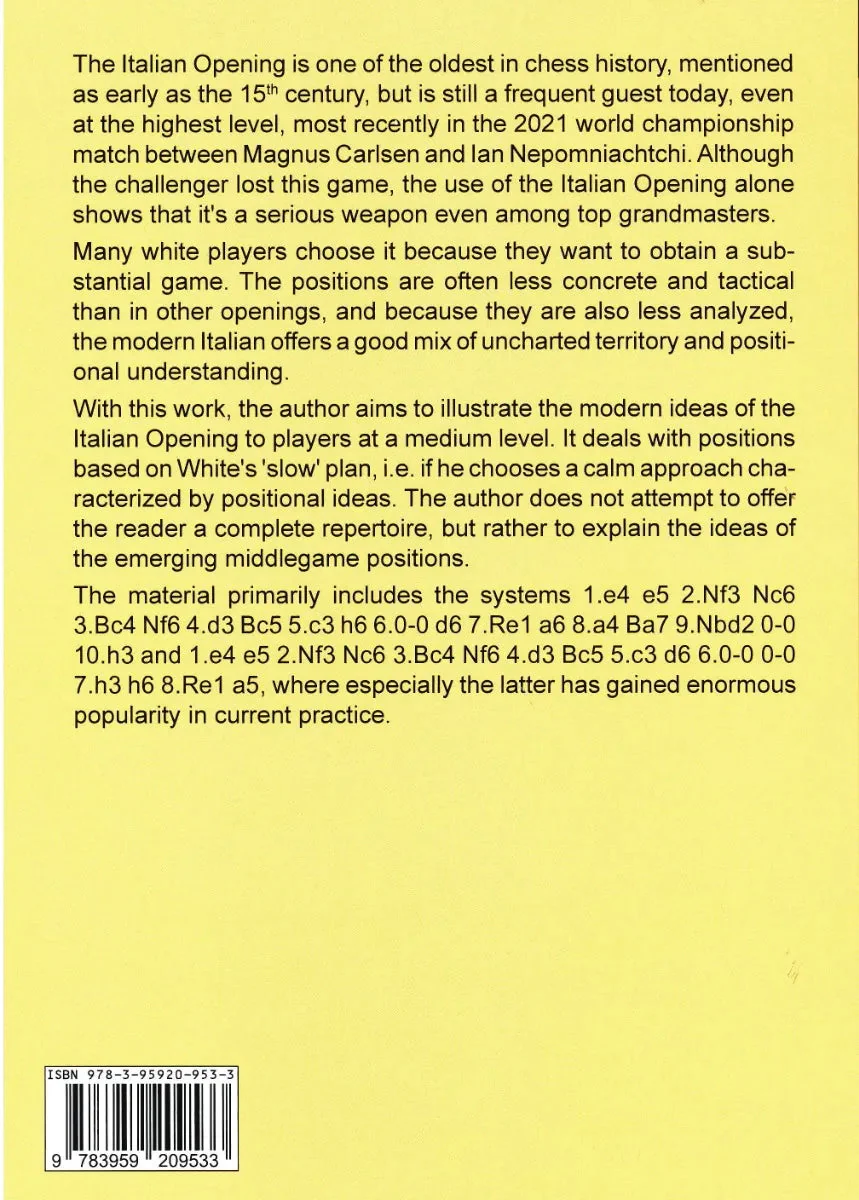
The Italian Opening is one of the oldest in chess history, mentioned as early as the 15th century, but is still a frequent guest today, even at the highest level, most recently in the 201 world championship match between Magnus Carlsen and Ian Nepomniachtchi. Although the challenger list this game, the use of the Italian Opening alone that it’s a serious weapon even among top grandmasters.
Many white players choose it because they want to obtain a substantial game. The positions are often less concrete and tactical than in other openings, and because thy are also less analyzed, the modern Italian offers a good mix of uncharted territory and positional understanding.
With this work, the author aims to illustrate the modern ideas of the Italian Openings to players at a medium level. It deals with positions on White’s ‘slow” plan, i.e. if he chooses a calm approach characterized by positional ideas. The author does not attempt to offer the reaser a complete repertoire, but rather to explain the ideas of the emerging middlegame positions.
The material primarily includes the systems 1.e4 e5 2.Nf3 Nc8 3.Bc4 Nf6 4.d3 Bc5 5.c3 h6 6.0-0 d6 7.Re1 a6 8.a4 Ba7 9.Nbd2 0-0 10.h3 and 1.e4 e5 2.Nf3 Nc6 3.Bc4 Nf6 4.d3 Bc5 5.c3 d6 6.0-0 0-0 7.h3 h6 8.Re1 a5, where especially the latter has gained enormous popularity in current practice.
Product Information
Product Information
Shipping & Returns
Shipping & Returns
Description
The Italian Opening is one of the oldest in chess history, mentioned as early as the 15th century, but is still a frequent guest today, even at the highest level, most recently in the 201 world championship match between Magnus Carlsen and Ian Nepomniachtchi. Although the challenger list this game, the use of the Italian Opening alone that it’s a serious weapon even among top grandmasters.
Many white players choose it because they want to obtain a substantial game. The positions are often less concrete and tactical than in other openings, and because thy are also less analyzed, the modern Italian offers a good mix of uncharted territory and positional understanding.
With this work, the author aims to illustrate the modern ideas of the Italian Openings to players at a medium level. It deals with positions on White’s ‘slow” plan, i.e. if he chooses a calm approach characterized by positional ideas. The author does not attempt to offer the reaser a complete repertoire, but rather to explain the ideas of the emerging middlegame positions.
The material primarily includes the systems 1.e4 e5 2.Nf3 Nc8 3.Bc4 Nf6 4.d3 Bc5 5.c3 h6 6.0-0 d6 7.Re1 a6 8.a4 Ba7 9.Nbd2 0-0 10.h3 and 1.e4 e5 2.Nf3 Nc6 3.Bc4 Nf6 4.d3 Bc5 5.c3 d6 6.0-0 0-0 7.h3 h6 8.Re1 a5, where especially the latter has gained enormous popularity in current practice.