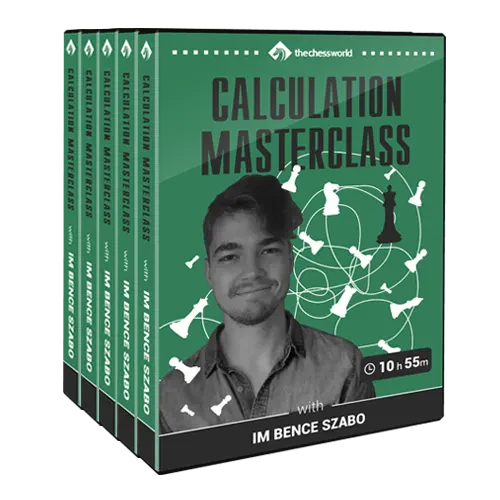
E-DVD Calculation Masterclass with IM Bence Szabo
Most club players – at least the ones I have met – are obsessed with one thing. How many moves they can think ahead…
Does it really matter?
I think it was Reti who said something like “one move but the best move”.
That’s what nobody tells you about calculation.
It’s not about how many moves you can calculate.
It’s about choosing the RIGHT lines to calculate.
There are many other things to know about calculation in chess. I won’t be the one to tell you. But IM Bence Szabo will…
Introducing his new 11-hour long video training Calculation Masterclass where he breaks down this complicated, subtle topic in a language that you will understand.
This training contains about…
Applying the “checks, captures and threats” tip before every move.
How to calculate the end of lines and visualize the end position properly.
Taking stock of your opponent’s resources and preempting his ideas.
Want to ramp up your calculation skills? This training is for you.
Here’s what you are going to learn:
- A deadly check. A check might be harmless, making you lose a tempo. Or, it can be deadly, resulting in your loss in a few moves! Take this game from 1977 as an example where a simple back rank check + a piece sacrifice did the trick.
- The backup plan. When you play a move, always have a backup plan. Here’s a puzzle: what do you Botvinnik played next as White against Capablanca? (You can get a full analysis of this game by Bence inside the training BTW.)
- What he got… Don’t merely calculate the predictable moves from your opponent. You should also think through the unpredictable ones. That’s how you recognize the “hidden” resources in a position before your opponent does.
- The commitment pitfall. What often happens is, you calculate a line half-heartedly, think it’s okay to play, and then figure out later that it gives the advantage to your opponent. Bence uses a game between Reti and Bogoljubov to prove this.
- Always active. Even before you start calculation, there’s a rule to remember. Always look for forcing moves. Do this every time you are about to move. You will instantly hack your way into adding an extra 200 points to your game.
So, enough said! Let’s get started!
Outline:
Chapter 1. Approaching a Critical Position
Chapter 2. Check, Captures & Attack part I
Chapter 3. Check, Capture & Attack part II
Chapter 4. Opponent’s Resources part I
Chapter 5. Opponent’s Resources part II
Chapter 6. Opponent’s Resources part III
Chapter 7. Opponent’s Resources part IV
Chapter 8. Opponent’s Resources Part V
Chapter 9. First Few Moves
Chapter 10. The Backup Plan Continuation
Chapter 11. The Backup Plan
Chapter 12. Always Active
Chapter 13. End of Lines
Chapter 14. Typical Mistakes part I
Chapter 15. Typical Mistakes part II
Chapter 16. Typical Mistakes part III
Chapter 17. Typical Mistakes part IV
Chapter 18. Prophylactic Thinking
Original: $128.95
-65%$128.95
$45.13E-DVD Calculation Masterclass with IM Bence Szabo
Most club players – at least the ones I have met – are obsessed with one thing. How many moves they can think ahead…
Does it really matter?
I think it was Reti who said something like “one move but the best move”.
That’s what nobody tells you about calculation.
It’s not about how many moves you can calculate.
It’s about choosing the RIGHT lines to calculate.
There are many other things to know about calculation in chess. I won’t be the one to tell you. But IM Bence Szabo will…
Introducing his new 11-hour long video training Calculation Masterclass where he breaks down this complicated, subtle topic in a language that you will understand.
This training contains about…
Applying the “checks, captures and threats” tip before every move.
How to calculate the end of lines and visualize the end position properly.
Taking stock of your opponent’s resources and preempting his ideas.
Want to ramp up your calculation skills? This training is for you.
Here’s what you are going to learn:
- A deadly check. A check might be harmless, making you lose a tempo. Or, it can be deadly, resulting in your loss in a few moves! Take this game from 1977 as an example where a simple back rank check + a piece sacrifice did the trick.
- The backup plan. When you play a move, always have a backup plan. Here’s a puzzle: what do you Botvinnik played next as White against Capablanca? (You can get a full analysis of this game by Bence inside the training BTW.)
- What he got… Don’t merely calculate the predictable moves from your opponent. You should also think through the unpredictable ones. That’s how you recognize the “hidden” resources in a position before your opponent does.
- The commitment pitfall. What often happens is, you calculate a line half-heartedly, think it’s okay to play, and then figure out later that it gives the advantage to your opponent. Bence uses a game between Reti and Bogoljubov to prove this.
- Always active. Even before you start calculation, there’s a rule to remember. Always look for forcing moves. Do this every time you are about to move. You will instantly hack your way into adding an extra 200 points to your game.
So, enough said! Let’s get started!
Outline:
Chapter 1. Approaching a Critical Position
Chapter 2. Check, Captures & Attack part I
Chapter 3. Check, Capture & Attack part II
Chapter 4. Opponent’s Resources part I
Chapter 5. Opponent’s Resources part II
Chapter 6. Opponent’s Resources part III
Chapter 7. Opponent’s Resources part IV
Chapter 8. Opponent’s Resources Part V
Chapter 9. First Few Moves
Chapter 10. The Backup Plan Continuation
Chapter 11. The Backup Plan
Chapter 12. Always Active
Chapter 13. End of Lines
Chapter 14. Typical Mistakes part I
Chapter 15. Typical Mistakes part II
Chapter 16. Typical Mistakes part III
Chapter 17. Typical Mistakes part IV
Chapter 18. Prophylactic Thinking
Product Information
Product Information
Shipping & Returns
Shipping & Returns
Description
Most club players – at least the ones I have met – are obsessed with one thing. How many moves they can think ahead…
Does it really matter?
I think it was Reti who said something like “one move but the best move”.
That’s what nobody tells you about calculation.
It’s not about how many moves you can calculate.
It’s about choosing the RIGHT lines to calculate.
There are many other things to know about calculation in chess. I won’t be the one to tell you. But IM Bence Szabo will…
Introducing his new 11-hour long video training Calculation Masterclass where he breaks down this complicated, subtle topic in a language that you will understand.
This training contains about…
Applying the “checks, captures and threats” tip before every move.
How to calculate the end of lines and visualize the end position properly.
Taking stock of your opponent’s resources and preempting his ideas.
Want to ramp up your calculation skills? This training is for you.
Here’s what you are going to learn:
- A deadly check. A check might be harmless, making you lose a tempo. Or, it can be deadly, resulting in your loss in a few moves! Take this game from 1977 as an example where a simple back rank check + a piece sacrifice did the trick.
- The backup plan. When you play a move, always have a backup plan. Here’s a puzzle: what do you Botvinnik played next as White against Capablanca? (You can get a full analysis of this game by Bence inside the training BTW.)
- What he got… Don’t merely calculate the predictable moves from your opponent. You should also think through the unpredictable ones. That’s how you recognize the “hidden” resources in a position before your opponent does.
- The commitment pitfall. What often happens is, you calculate a line half-heartedly, think it’s okay to play, and then figure out later that it gives the advantage to your opponent. Bence uses a game between Reti and Bogoljubov to prove this.
- Always active. Even before you start calculation, there’s a rule to remember. Always look for forcing moves. Do this every time you are about to move. You will instantly hack your way into adding an extra 200 points to your game.
So, enough said! Let’s get started!
Outline:
Chapter 1. Approaching a Critical Position
Chapter 2. Check, Captures & Attack part I
Chapter 3. Check, Capture & Attack part II
Chapter 4. Opponent’s Resources part I
Chapter 5. Opponent’s Resources part II
Chapter 6. Opponent’s Resources part III
Chapter 7. Opponent’s Resources part IV
Chapter 8. Opponent’s Resources Part V
Chapter 9. First Few Moves
Chapter 10. The Backup Plan Continuation
Chapter 11. The Backup Plan
Chapter 12. Always Active
Chapter 13. End of Lines
Chapter 14. Typical Mistakes part I
Chapter 15. Typical Mistakes part II
Chapter 16. Typical Mistakes part III
Chapter 17. Typical Mistakes part IV
Chapter 18. Prophylactic Thinking