
Red and Natural Bone
India has a rich association with chess. The modern version of chess is linked to an earlier version called Shatranj that evolved in Indian from around the 6th century AD, which is thought to have been derived from an earlier game called Chaturanga. India had the materials and expert craftsmen needed to make fine objects and chess sets were a natural fit.
The British East Indian Company was setup in India in the early 1600s and by the later part of the 1700s they controlled much of India’s exports. A vast amount goods were created in India and exported to Europe (mostly Britain) to fulfill demand. The lower cost of skilled labor in India allowed the items to be priced competitively. The majority of their chess sets were created for, and targeted at, the export market where demand was strong. This affected the design and themes of the sets themselves, which were often very elaborately carved and turned.
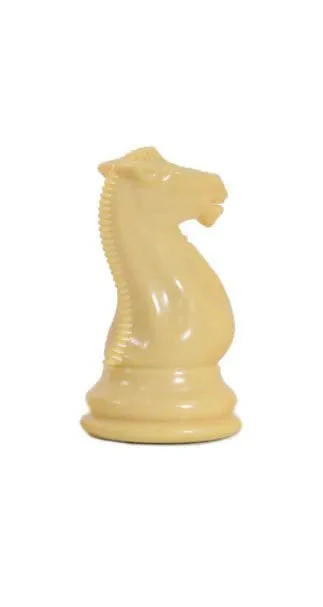
In order to compete in their own British marketplace against the flood of Indian-made chess sets using cheap Indian labor, many of the established English craftsmen turned to copying or modifying the more elaborate Indian chessmen designs that were being imported and adding features and embellishments of their own, such as distinctive Knight heads and rusticated pedestal Rooks. One of these English manufacturers was Thomas Lund. His workshop was located at 57 Cornhill, London. His sets were often stamped “ THOMAS LUND Maker 57 CORNHILL”. His son, William Lund, was located at 23-24 Fleet Street. Thomas Lund had several occupations, but one of them was the manufacture of chess sets from the early 1800's until his death in 1843. William Lund, Thomas' son, continued to make sets throughout the rest of the 19th century, and is one of the most well-known of the manufacturers. This particular style was most likely made by Thomas Lund.
THESE ARE ACTUAL HAND CARVED BONE CHESSMEN
Red and Natural Bone
India has a rich association with chess. The modern version of chess is linked to an earlier version called Shatranj that evolved in Indian from around the 6th century AD, which is thought to have been derived from an earlier game called Chaturanga. India had the materials and expert craftsmen needed to make fine objects and chess sets were a natural fit.
The British East Indian Company was setup in India in the early 1600s and by the later part of the 1700s they controlled much of India’s exports. A vast amount goods were created in India and exported to Europe (mostly Britain) to fulfill demand. The lower cost of skilled labor in India allowed the items to be priced competitively. The majority of their chess sets were created for, and targeted at, the export market where demand was strong. This affected the design and themes of the sets themselves, which were often very elaborately carved and turned.
In order to compete in their own British marketplace against the flood of Indian-made chess sets using cheap Indian labor, many of the established English craftsmen turned to copying or modifying the more elaborate Indian chessmen designs that were being imported and adding features and embellishments of their own, such as distinctive Knight heads and rusticated pedestal Rooks. One of these English manufacturers was Thomas Lund. His workshop was located at 57 Cornhill, London. His sets were often stamped “ THOMAS LUND Maker 57 CORNHILL”. His son, William Lund, was located at 23-24 Fleet Street. Thomas Lund had several occupations, but one of them was the manufacture of chess sets from the early 1800's until his death in 1843. William Lund, Thomas' son, continued to make sets throughout the rest of the 19th century, and is one of the most well-known of the manufacturers. This particular style was most likely made by Thomas Lund.
THESE ARE ACTUAL HAND CARVED BONE CHESSMEN
Product Information
Product Information
Shipping & Returns
Shipping & Returns
Description
India has a rich association with chess. The modern version of chess is linked to an earlier version called Shatranj that evolved in Indian from around the 6th century AD, which is thought to have been derived from an earlier game called Chaturanga. India had the materials and expert craftsmen needed to make fine objects and chess sets were a natural fit.
The British East Indian Company was setup in India in the early 1600s and by the later part of the 1700s they controlled much of India’s exports. A vast amount goods were created in India and exported to Europe (mostly Britain) to fulfill demand. The lower cost of skilled labor in India allowed the items to be priced competitively. The majority of their chess sets were created for, and targeted at, the export market where demand was strong. This affected the design and themes of the sets themselves, which were often very elaborately carved and turned.
In order to compete in their own British marketplace against the flood of Indian-made chess sets using cheap Indian labor, many of the established English craftsmen turned to copying or modifying the more elaborate Indian chessmen designs that were being imported and adding features and embellishments of their own, such as distinctive Knight heads and rusticated pedestal Rooks. One of these English manufacturers was Thomas Lund. His workshop was located at 57 Cornhill, London. His sets were often stamped “ THOMAS LUND Maker 57 CORNHILL”. His son, William Lund, was located at 23-24 Fleet Street. Thomas Lund had several occupations, but one of them was the manufacture of chess sets from the early 1800's until his death in 1843. William Lund, Thomas' son, continued to make sets throughout the rest of the 19th century, and is one of the most well-known of the manufacturers. This particular style was most likely made by Thomas Lund.
THESE ARE ACTUAL HAND CARVED BONE CHESSMEN